Social Proof · FOMO Elements
Urgency, backed by real data. Never fabricated.
Low-stock depletion meters. Units-sold counters. Live visitor counts. Three urgency signals personalised per audience and A/B-tested against your conversion. When the data does not qualify, the element hides instead of faking it.
What it does
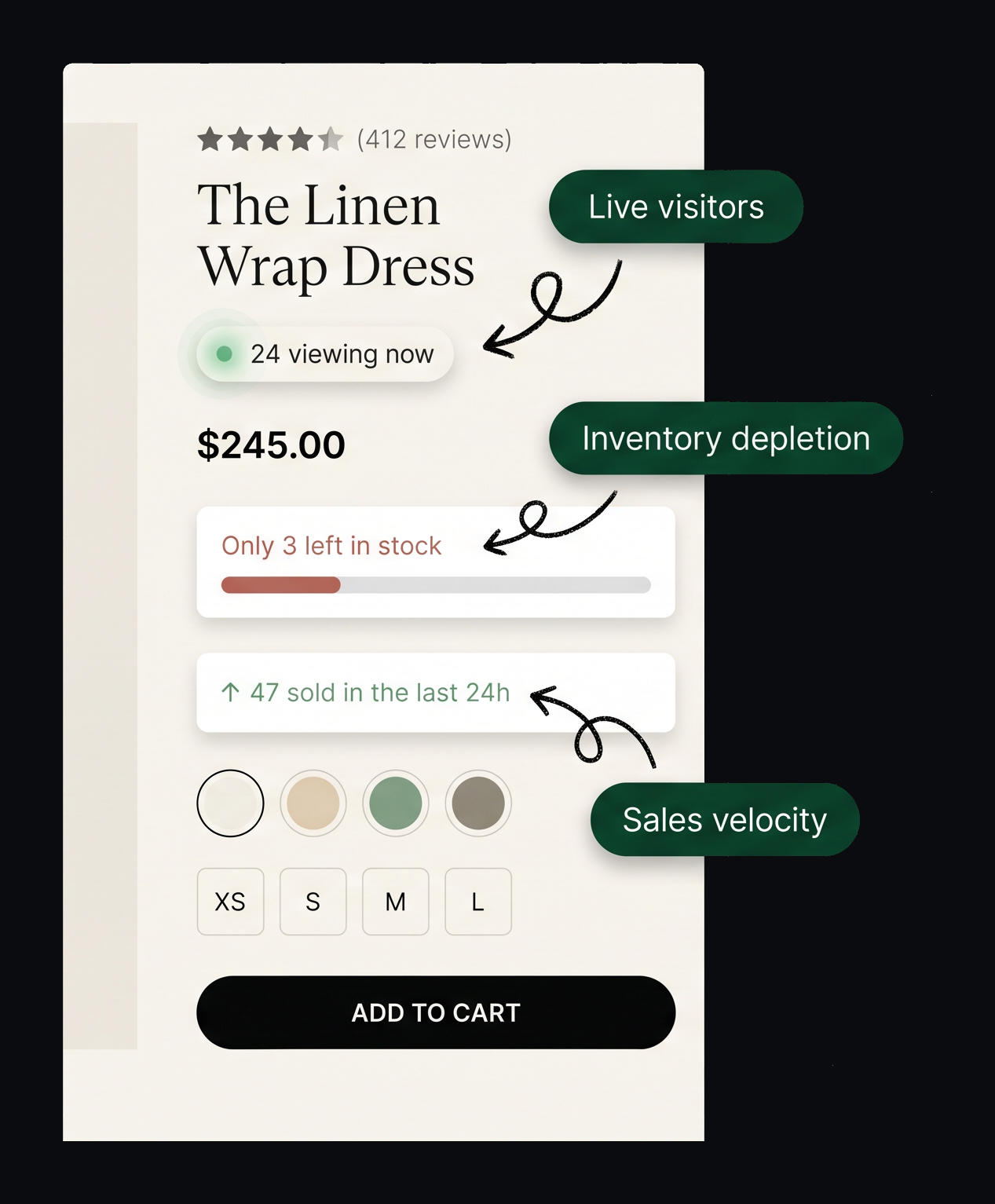
Three urgency signals. One platform. All grounded in real signals from your store.
Low-stock callout with depletion meter
Inline message ("Only 3 left") or card-style depletion meter with a horizontal fill bar. Multi-tier thresholds let you set different messages, icons, and urgency per stock range. Hides silently when nothing qualifies.
Units-sold velocity counter
Metafield-driven "{count} sold in the last {period}" with three number formats (exact, rounded, abbreviated). Configurable min-count gate so a thin signal never embarrasses the page.
Live visitor count
Real-time "24 people are viewing this right now" with a pulsing live indicator. Data-pipeline-agnostic via a product metafield. Min-count threshold hides it when traffic is too low to be social proof.
Audience targeting on every signal
Nine operators across page, device, cart value, UTM, customer tags, geo, and referrer. Show different urgency configurations to first-time visitors vs. returning customers, paid vs. organic, mobile vs. desktop.
Native A/B experimentation
Test whether "Only 3 left" actually drives more conversions than no callout. Run multi-variant experiments via Studio without leaving the platform. The only FOMO toolkit on Shopify with native experimentation.
Inventory reorder alerts
An AI playbook ranks products approaching stockout by sales velocity and supplier lead time. You hear about it before the low-stock callout fires on the storefront. The two systems work together.
Why it matters
Real urgency lifts conversion. Fabricated urgency damages trust.
15–30%
Conversion lift from social proof
Product pages with social proof signals convert at meaningfully higher rates than those without.
ProveSource, 75 Social Proof Statistics for 2026
40%+
Sales lift from FOMO marketing
Across industries, FOMO-driven mechanics increase sales by at least 40% when grounded in real signals.
ConvertMate FOMO research
68%
Feel manipulated by fake urgency
Shoppers report distrust toward perpetual countdowns and fabricated scarcity. Real data is the only kind worth showing.
Poper, sales countdown timer psychology
Three snippets, one playbook, running today.
Each FOMO element is a configurable Spectrum snippet. The inventory reorder alerts playbook keeps the data behind them honest. Everything ships out of the box.
FOMO: Low Inventory snippet
LiveMulti-tier stock thresholds, inline or depletion-meter display, per-tier message and urgency overrides. Pulse animation on urgent tiers (respects prefers-reduced-motion). 10 style nodes for full visual control.
FOMO: Sales Velocity snippet
LiveMetafield-driven units-sold counter with template placeholders for count and period. Three number formats, configurable min-count gate, custom icon (emoji or uploaded image).
FOMO: Live Visitors snippet
LiveReal-time visitor count with a pulsing live indicator dot. Data-pipeline-agnostic, the snippet renders whatever count arrives via the product metafield. Same three number formats, min-count threshold.
Inventory reorder alerts playbook
LiveTracks products approaching stockout by sales velocity and optional supplier lead-time metafield. Ranks alerts by urgency. Configurable lookback window. Read-only, low-risk.
Built for
Brands where urgency is real, and the audience knows the difference.
Apparel & Fashion
Variant-level inventory is where scarcity actually lives. Show "Only 2 left in your size" on the live variant, not a fabricated count on the parent SKU. Multi-tier thresholds escalate when stock genuinely drops.
Beauty & Personal Care
Limited drops, seasonal SKUs, restock cycles. Real velocity counters tell shoppers a hero product is moving without manufacturing urgency on the slow movers. Different urgency by acquisition source.
High-consideration purchases
For premium goods, fake urgency damages trust more than it lifts conversion. Spectrum hides when no tier matches. Honest signals on a confident page beat fabricated countdowns every time.
Multi-segment brands
Wholesale and retail visitors see different urgency. New-to-brand traffic from paid campaigns gets a depletion meter; returning customers get a subtle inline message. Same product page, different audiences.
What it replaces
Fomo, Nudgify, Urgency+ charge per impression. Spectrum doesn't.
The legacy FOMO apps gate features behind impression-based pricing, silent caps, and billing disputes. Spectrum ships the same surface as a focused, AI-native, audience- targeted feature inside the platform you already use for everything else.
FAQ
Questions, answered.
A few we hear most often. Want to walk through it on your catalog? Book a demo.
Talk to a humanWhat if I do not have the inventory or visitor data?
The snippet hides silently. We are explicit about this: low-stock callouts only render when a tier actually matches; velocity and visitor counters only render when the count clears their min-count gate. No fabricated numbers, ever.
Will my page slow down with these elements installed?
Snippets are small Liquid blocks with the same shared bundle as the rest of Spectrum. No per-feature script bloat. Real measurements: the three FOMO elements together add a fraction of the JavaScript a dedicated app like Fomo or Nudgify would.
How does the live visitor count actually work?
It reads from a product metafield (`spectrum.visitors_callout`) that you populate however suits your traffic shape. Snippet is data-pipeline-agnostic, so you can wire it to a real-time analytics source or a periodic batch. The render layer is the same either way.
Can I show different urgency to wholesale and retail customers?
Yes. Customer tags is one of the targeting operators. Tag your wholesale accounts, point the targeting tree at the tag, and configure a different FOMO setup for that segment. The retail experience stays unchanged.
Can I A/B test whether showing "Only 3 left" actually drives conversions?
Yes. This is the question most operators want answered. Spectrum is the only FOMO toolkit on Shopify with native A/B experimentation. Set up an experiment, ship variants, the platform measures conversion lift for you.
See urgency that hides when it doesn't qualify.
A 20-minute walk-through. Real inventory tiers, real velocity, real visitor counts, on your products, in your audience segments.
Join the Waitlist